How to Evaluate an Independent Watch Workshop
Finding someone trustworthy to open a mechanical timepiece requires looking past marketing slogans. What diagnostic machines sit on their bench? How do they handle insurance, parts access, and photographic documentation?
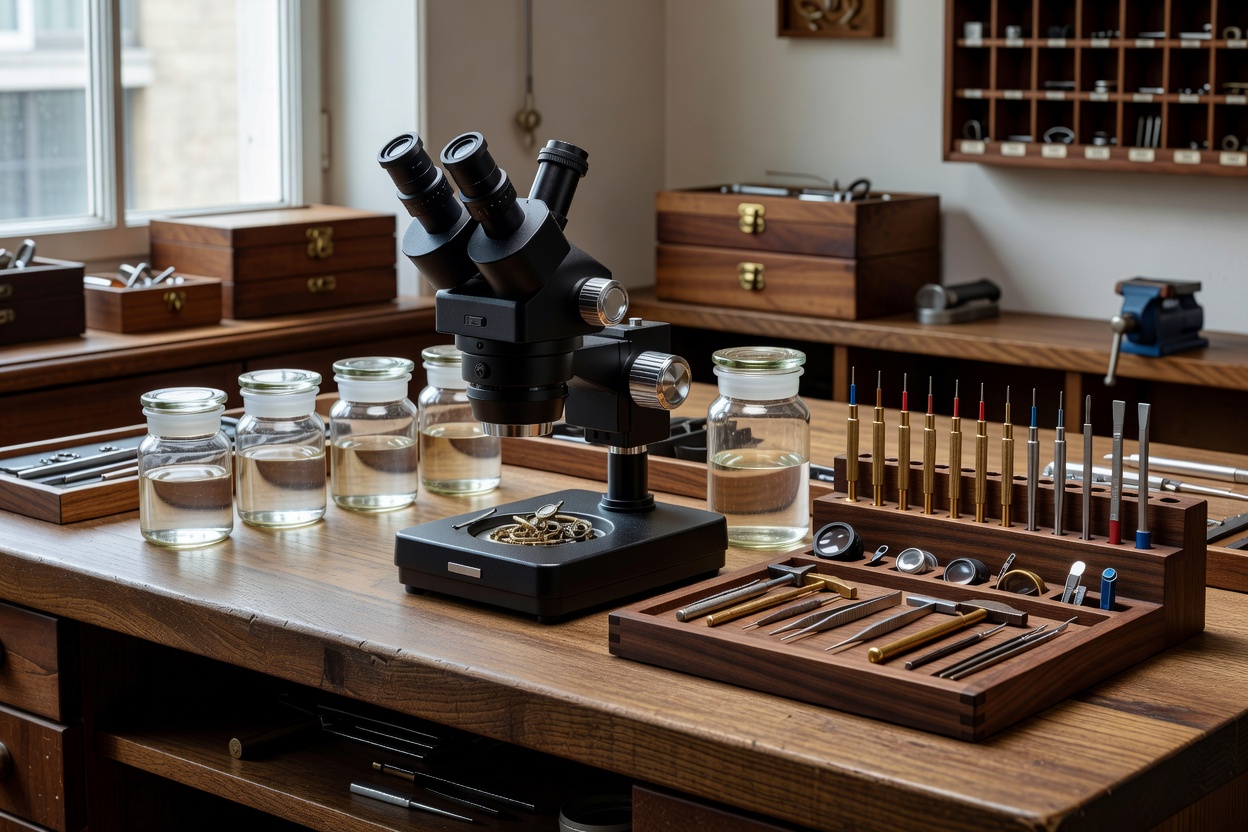
A professional horologist atelier maintains strict dust control, anti-static work surfaces, and specialized acoustic measurement rigs.
The Four Essential Workshop Categories
Across Switzerland, Germany, the United Kingdom, and the wider European continent, workshops fall into four distinct operational models. Recognizing which type matches your watch's needs is the first step toward a successful outcome.
Authorized Brand Service Centers
Directly owned by major luxury conglomerates or authorized via strict licensing agreements. They possess guaranteed OEM parts channels and proprietary case tooling. However, they frequently enforce mandatory component replacements (new dials, new hands) and have fixed pricing schedules with turnaround times often stretching from 6 to 12 months.
Certified Independent Ateliers
Run by accredited master watchmakers (e.g., WOSTEP, British Horological Institute, or Swiss Federal Diploma holders). They hold level-3 or level-4 brand parts accounts, operate cleanroom laminar benches, and communicate directly with the owner, offering custom preservation decisions.
Specialist Antique & Restoration Ateliers
These workshops concentrate on vintage calibres, obsolete chronographs, and pocket watches. Their primary strengths lie in lathe fabrication, wheel cutting, hairspring vibration, laser welding, and dial stabilization. They rarely handle modern ceramic dive watches, focusing instead on museum-grade preservation.
High-Street Commercial Repair Shops
Generalist jewelers handling quartz battery swaps, crystal glued replacements, and basic ETA movement drops. Generally unsuited for high-grade mechanical watches or delicate vintage chronographs due to lack of multi-position acoustic timing gear and specialized cleaning baths.
Key Evaluation Criteria: What to Verify
1. Diagnostic and Cleaning Tooling
A high-standard atelier should openly share what machinery they use. Look for:
- Automated Ultrasonic Cleaning Machines: Multi-jar systems (such as Elma Solvex or Greiner) that clean, rinse in multiple petroleum distillates, and heat-dry parts without human contact.
- Acoustic & Optical Timegraphers: Witschi Chronoscope or equivalent units capable of measuring amplitude, beat error, and rate across 5 or 6 positions.
- Pressure Chambers: Both dry deformation testing (e.g., Witschi Proofmaster) and wet chamber testing (e.g., Bergeon 5555) for verifying water resistance safely.
2. Parts Sourcing and Authenticity
Parts supply has grown increasingly restricted over the past two decades. Ask frankly: Does the atelier have direct accounts for the movement brand, do they source NOS (New Old Stock) parts, or do they machine replacements on a watchmaker lathe? Clear, honest disclosure about parts provenance is the hallmark of a reputable watchmaker.
3. Photographic Intake and Condition Reports
A reputable horologist never opens a valuable timepiece without producing a formal intake report. This should document:
- Pre-existing hairline scratches, lug marks, or crystal chips
- Dial condition under high magnification (checking for invisible hairspring radium burns or edge chipping)
- Baseline timing trace (amplitude, rate, beat error)
- Serial numbers on case, caseback, and movement bridge
4. Transit Insurance and Return Guarantees
If shipping across European borders (e.g., between the UK, Germany, and Switzerland), verify whether the atelier provides specialized insured couriers (such as Ferrari Logistics or specialized Secursus coverage) rather than standard postal parcels. Standard parcel carriers routinely exclude wristwatches above modest values in their fine print.
Workshop Question Builder
Select the questions you want to ask a prospective workshop. The tool compiles your list below for easy printing or copying.
Generated Question Summary
Frequently Asked Questions on Ateliers
Should I always send my watch to the manufacturer instead of an independent?
Not necessarily. For modern, under-warranty watches, authorized brand service centers are often appropriate. For vintage pieces, independent master watchmakers are frequently superior because they respect original patina and allow you to decline cosmetic case refinishing or dial replacement.
What formal certifications should European watchmakers hold?
Look for recognized training programs: WOSTEP (Watchmakers of Switzerland Training and Educational Program), Swiss Federal VET Diplomas, German Uhrmachermeister (Master Watchmaker) credentials, or Fellowship of the British Horological Institute (FBHI).
What if a workshop damages a part that cannot be replaced?
Competent restoration ateliers maintain both high-level professional indemnity insurance and micro-machining equipment to turn or spark-erode a replacement part to exact factory tolerances if an obsolete component fractures.
Need help formulating questions for a specific calibre?
Our editorial team provides independent educational guidance on workshop protocols across Europe.