What Mechanical Servicing Actually Entails
A full mechanical watch overhaul is not a quick squirt of lubricant or a wipe with a microfiber cloth. It is a meticulous teardown of over one hundred micro-engineered components, followed by scientific cleaning, exact oiling, and dynamic multi-position regulation.
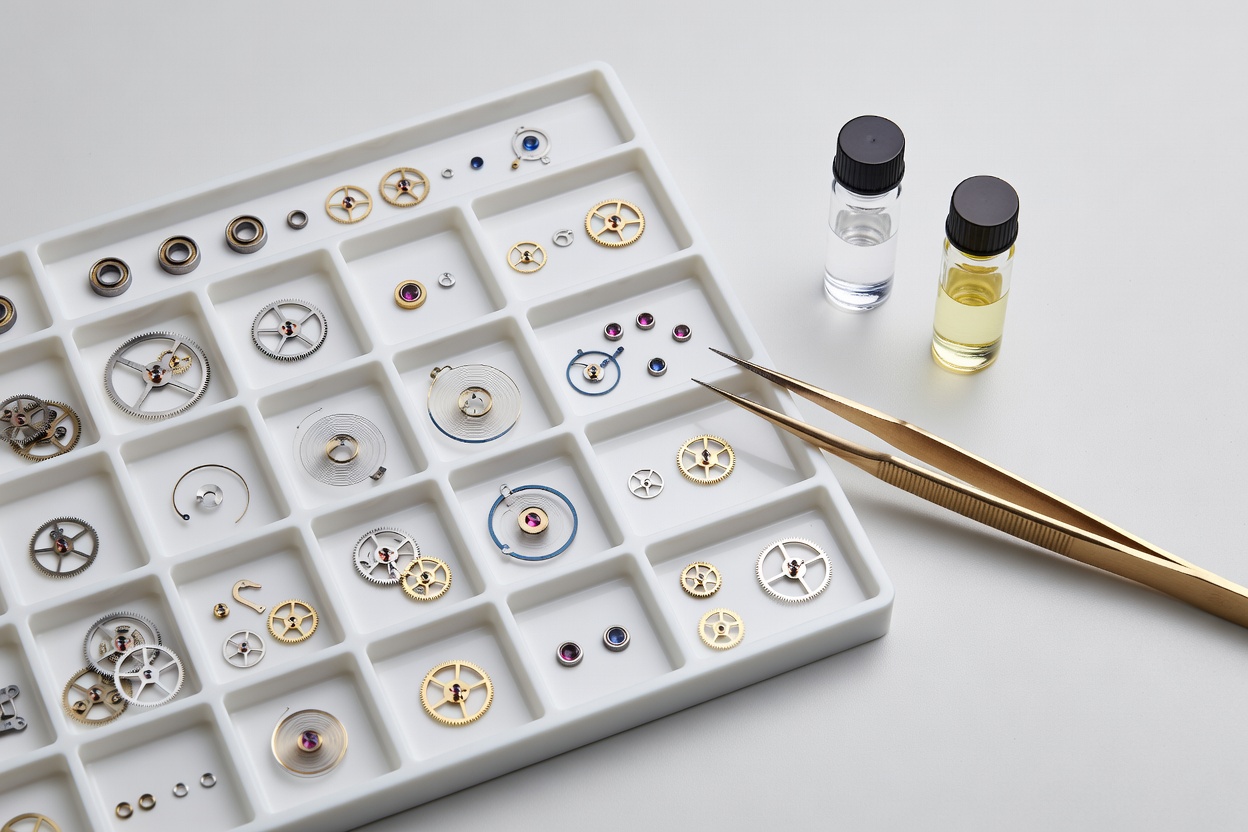
Every component—from the mainspring barrel to the microscopic balance shock springs—is separated, cataloged, and inspected for wear under 15x magnification.
The Anatomy of a Complete Mechanical Overhaul
When you hand your watch over to an experienced watchmaker, the process follows a rigorous protocol developed over generations and refined by modern tribology. A common misconception is that a running watch needs no attention. In reality, modern synthetic oils dry out over years, turning into an abrasive sludge that gradually grinds down pivot pinions and brass jewel holes.
1. Initial Diagnostics and Casing Decoupling
The watchmaker begins with baseline testing. Before any screw is loosened, the watch is placed on a timegrapher to record its amplitude, daily rate variance, and beat error in all five standard positions. A preliminary dry pressure test assesses the current gasket integrity. The caseback is then removed in a dust-controlled environment, the crown and winding stem are extracted, and the movement is uncased with hands and dial carefully protected under dial protectors.
2. Teardown and Ultrasonic Cleansing
The movement is systematically disassembled into individual plates, bridges, gears, springs, and screws. The balance assembly and pallet fork are unmounted with extreme caution. All parts are placed in specialized mesh baskets and run through an automated cleaning machine featuring successive baths: an ultrasonic degreaser, multiple rinses of pure solvent, and a forced warm-air drying chamber.
Crucial escapement parts are treated with an epilame barrier film (such as Fixodrop). This microscopic fluorinated coating prevents high-mobility synthetic oils from creeping away from the impulse faces of the ruby pallet jewels.
3. Reassembly and Multi-Point Tribology
Reassembly occurs on the watchmaker's bench under clean laminar airflow. A watchmaker never uses a single generic oil. A modern mechanical movement requires up to four or five specialized lubricants:
- Moebius 9010: Low-viscosity synthetic oil for fast-moving pivots like the balance staff and escape wheel.
- HP 1300 (Moebius 9104): High-viscosity synthetic lubricant for high-torque areas, including center wheels and third wheel pivots.
- Moebius 9415: Formulated specifically for the pallet jewel impulse faces of 28,800 vph movements, providing thixotropic slip during contact.
- Moebius 8217 or Klüber: High-drag braking grease applied to the cylinder walls of automatic mainspring barrels to ensure smooth bridle slipping.
A Word on Service Intervals
You will often hear rigid claims that every watch must be serviced precisely every 3 or 5 years. In truth, intervals vary according to how frequently the piece is worn, case seal design, movement frequency, and storage conditions. A modern sealed diver worn in rotation may run happily for 6 to 8 years before amplitude drops, whereas a vintage chronograph with non-screwdown pushers may benefit from gasket and inspection checks every 2 to 3 years.
4. Regulation and 5-Position Calibration
Once reassembled, the movement is regulated. The watchmaker adjusts the effective length of the hairspring (via the regulator index or free-sprung variable inertia screws on the balance rim) to eliminate rate variance across dial-up, dial-down, crown-up, crown-left, and crown-right positions. Temperature and isochronism (rate consistency from full wind down to 24 hours of reserve) are monitored over several days.
5. Casing, Gasket Renewal, and Pressure Chambers
The case is cleaned (separately from the movement), and all synthetic rubber or Teflon gaskets—caseback, crown tube, and chronograph pushers—are renewed and lubricated with silicone grease. The movement is recased, dust-cleared with filtered ionized air, and closed to factory torque specs. The assembled watch then enters dry vacuum chambers to check case deformation, followed by wet pressure chambers where rated.
Routine Servicing vs. Spot Repairs
| Characteristic | Complete Overhaul | Spot Repair / Minor Fix |
|---|---|---|
| Scope | 100% teardown, full degrease, all lubricants renewed | Isolated repair (e.g., replacing broken spring or loose screw) |
| Contamination Risk | Eliminated through full ultrasonic cleaning cycle | High; old dried oil remains inside adjacent wheel pivots |
| Water Resistance | Full gasket replacement and multi-stage pressure test | Typically untested or limited to basic dry vacuum test |
| Warranty Coverage | 12 to 24 months across total mechanical function | Limited strictly to replaced component |
Common Servicing Mistakes Watch Owners Make
- Ignoring significant loss of power reserve: When a 42-hour movement suddenly stops after 16 hours, the mainspring is either slipping prematurely or gear pivots are binding. Running it wears down the brass teeth.
- Permitting aggressive cosmetic polishing: Many high-volume service centers buff cases on rotary wheels without asking, softening historic chamfers and erasing lug numbers.
- Trusting quick "while-you-wait" oiling: Lubricating a dirty watch adds fresh oil on top of metallic dust, creating a grinding paste that rapidly destroys pivots.
What to Ask a Workshop Before Servicing
- Do you perform all work in-house, or is the movement outsourced to an external contractor?
- Will you preserve all original exterior parts (dial, hands, bezel) unless replacement is explicitly authorized in writing?
- What diagnostic timing and pressure testing reports are provided upon completion?
- What is your policy regarding returning worn components that have been replaced?
Common Questions on Mechanical Servicing
How do I know if my watch is ready for a service?
Key indicators include erratic timekeeping (gaining or losing more than 15–20 seconds per day unexpectedly), noticeably reduced power reserve, a gritty feeling when winding the crown, or condensation fogging under the sapphire crystal.
Why does servicing take several weeks or months?
Beyond the active bench hours required for disassembly and cleaning, quality workshops submit movements to multi-day timing observation, simulating wrist movement on automated winders to guarantee stability across temperature and mainspring unwinding cycles.
Can I take my mechanical watch into water after servicing?
Only if the workshop has issued a passing water-resistance test receipt for the required depth. Even freshly serviced dive watches should have their crowns screwed down finger-tight before entering water, and pushers must never be operated submerged unless specifically engineered to do so.
Need to prepare your watch for bench intake?
Use our interactive pre-service checklist or consult our atelier question builder.