Restoration Versus Routine Servicing
Restoration is an entirely different philosophy from scheduled servicing. Where servicing replaces worn standard parts with modern inventory, restoration balances mechanical viability against historical authenticity, patina preservation, and material ethics.
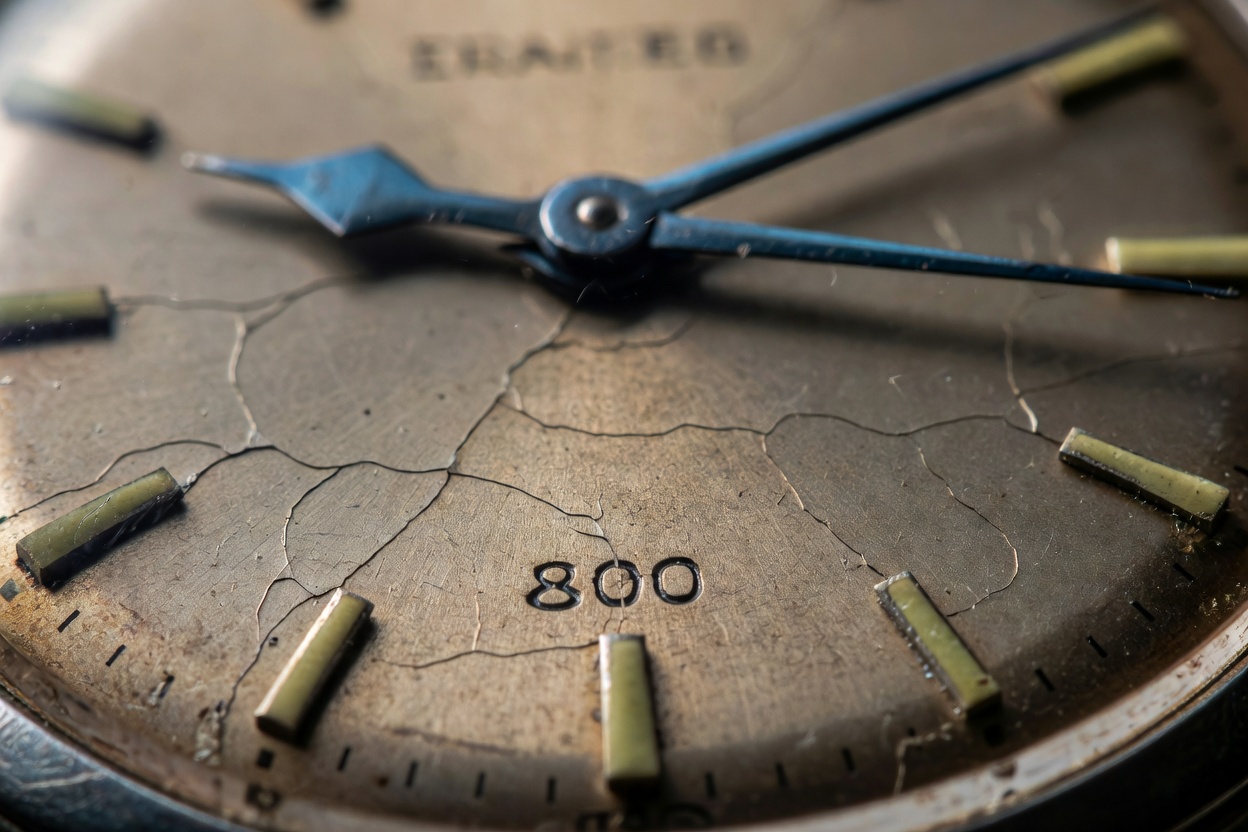
Original lacquer crazing, radium burn, and oxidation are historical artifacts. A sympathetic conservator seeks to stabilize decay without erasing history.
Defining the Boundary: Servicing or Restoring?
In the horological world, confusing restoration with servicing causes irreversible harm. When an owner sends an intact 1960s mechanical chronograph to a conventional commercial service facility, standard operating procedure often calls for replacing the aged dial, discarding oxidized original hands, and polishing the stainless steel case until every surface gleams like chrome.
To a collector or museum conservator, that outcome is a catastrophe. You receive a watch that functions mechanically, but its historical character has been obliterated. Restoration, properly understood, is the art of reviving mechanical integrity while treating the timepiece as an irreplaceable historical object.
Dial Preservation: The Non-Negotiable Rule
The dial is the soul of any vintage mechanical watch. Once a dial has been reprinted, repainted, or stripped down to raw brass, its authenticity cannot be retrieved. Specialist restorers follow strict conservation rules:
- Stabilization over Repainting: If clear lacquer is flaking, micro-adhesives are applied under stereo-microscopes to arrest delamination without adding new pigments.
- Luminous Compounds: Radium (pre-1960) and Tritium (1960–1998) degrade into distinctive cream, amber, or chocolate tones. Restorers do not strip this luminous material unless it has physically crumbled into the movement train. If stabilization is necessary, invisible binders are applied from behind.
- Refinishing Warnings: A redial should only ever be considered when the original dial metal is corroding into structural powder, and even then, full disclosure and documentation are mandatory.
Case Geometry: The Danger of the Buffing Wheel
Every watch case is designed with subtle geometric intentions: crisp factory bevels (chamfers), brushed flank graining, and mirror-polished bezels. Traditional buffing wheels remove metal indiscriminately, rounding sharp lug transitions and turning circular hole openings into ovals.
Modern restoration utilizes two advanced techniques:
- Micro Laser-Welding: When deep gouges or dents compromise a lug or case edge, microscopic wires of identical metallurgical alloy (e.g., 316L steel or specific gold karats) are laser-melted into the void. This restores metal volume without shaving down the surrounding area.
- Lapping Machine Refinishing: A rigid cast-iron or zinc lapidary wheel, operating at calibrated angles, recreates crisp factory-spec planar facets without rounding edges.
Commercial Value Disclaimer
It is important to remember that restoration does not guarantee an increase in monetary resale value. In fact, over-restored pieces frequently lose substantial market value among collectors who prioritize untouched, authentic condition. Restoration is undertaken for personal preservation and mechanical revival, not financial speculation.
Movement Component Fabrication
When working on antique calibres, obsolete pocket watches, or low-production calibres from defunct manufacturers, replacement components cannot be ordered from a parts catalog. The restorer must step away from modern screwdrivers and sit at the watchmaker's lathe (such as a Bergeon or Schaublin lathe).
Common fabricated parts include:
- Balance Staffs: Turned from tempered steel rod, hand-burnished on a Jacot pivot lathe until the pivots measure just 0.08mm to 0.12mm in diameter.
- Winding Stems and Setting Levers: Milled and filed from carbon steel, heat-treated, and blued.
- Bushing Worn Jewel Holes: Re-bushing worn brass plates to correct wheel center distances and eliminate gear mesh binding.
Comparing Conservation Approaches
| Component | Preservation / Sympathetic | Aggressive Over-Restoration |
|---|---|---|
| Dial | Surface cleaned dry, lacquer stabilized, patina retained | Stripped, reprinted with modern fonts, luminous stripped |
| Hands | Corrosion arrested, original plating & tritium kept | Discarded for brand-new modern factory service replacements |
| Case | Ultrasonic washed, laser-welded only if structurally compromised | Heavily polished on wheel, softening crisp lugs and case lines |
| Movement | Ultrasonic cleaned, pivots polished, custom parts made to original specs | Modern non-conforming screws inserted, mismatched parts forced |
What to Clarify with a Restoration Workshop
- Will you provide a detailed photographic condition report prior to dismantling?
- Do you guarantee that no dial or hand components will be replaced without my explicit consent?
- If custom parts must be fabricated, will they match original metallurgical and finishing standards?
- Will all replaced original parts be returned to me in secure labeled vials?
Common Questions on Watch Conservation
Should I polish my vintage watch case?
In almost all circumstances, conservators recommend leaving honest wear marks alone. Surface scratches represent the history of the watch. Aggressive polishing irreversibly removes metal and diminishes the sharp geometry that defined the original case design.
Is it safe to wear a watch with original radium paint?
Intact radium dials inside sealed cases pose minimal external radiation hazard because the crystal and metal case block alpha and most beta particles. However, radium is dangerous if inhaled or ingested when the case is opened. Only professional ateliers equipped with radiation containment should handle radium dials.
Can water resistance be restored on a 50-year-old watch?
Often no. Vintage casebacks, pushers, and crystals may have slight corrosion pitting along gasket seating tracks. Even with fresh gaskets, vintage watches should generally be treated as strictly non-water-resistant unless they pass modern dry vacuum and wet testing under strict bench supervision.
Planning a restoration inquiry?
Review our atelier evaluation criteria or send a direct question to our technical desk.