Movement Architecture & Owner Care
Inside a mechanical watch case resides a kinetic engine operating continuously for years on end. Understanding how energy flows from mainspring to escapement clarifies why magnetism, shock, and oil degradation impact accuracy.
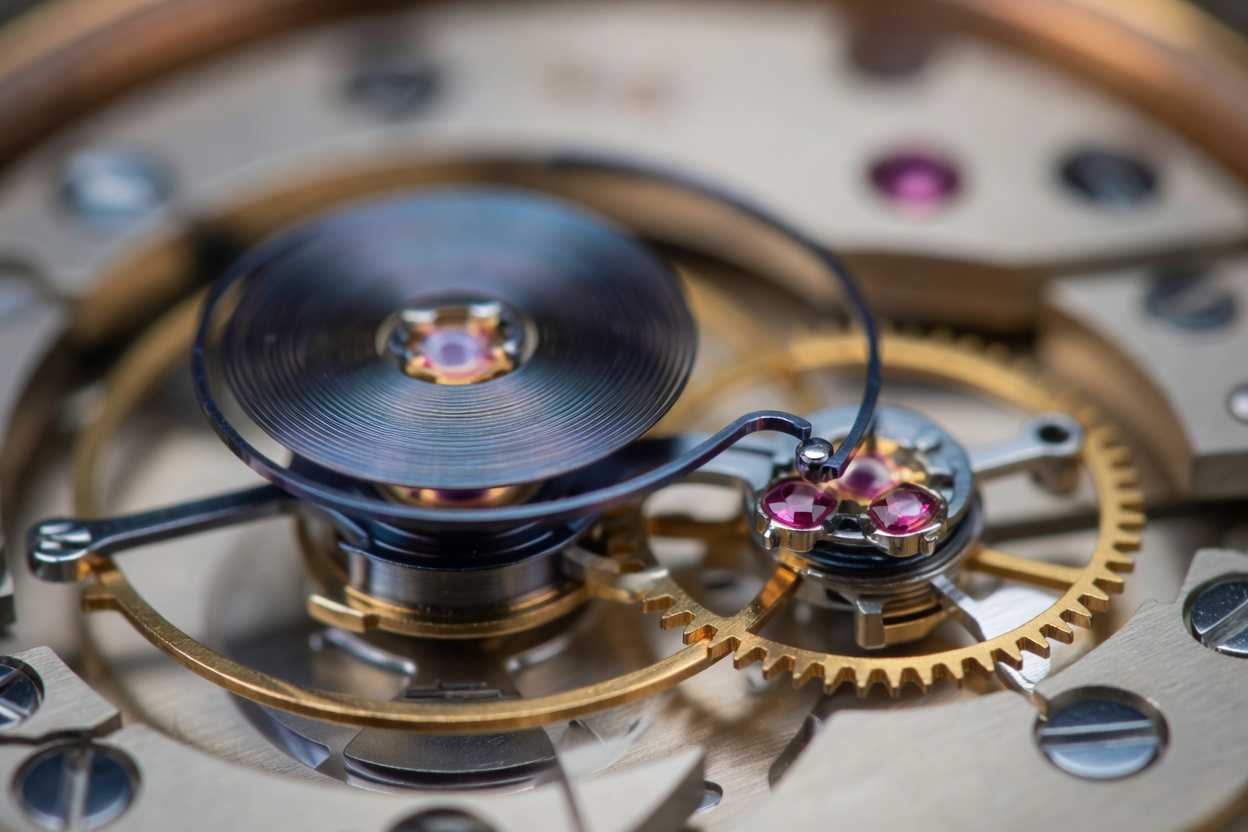
The balance wheel oscillates back and forth up to 36,000 times per hour. The microscopic clearance between ruby pallet stones and escape teeth is less than 0.02 millimeters.
How a Mechanical Movement Operates
Whether hand-wound or automatic, every mechanical wristwatch relies on five interrelated mechanical assemblies. Appreciating this kinematic chain transforms how you wear, wind, and store your watch.
Figure 1: Kinetic transmission from barrel to dial display.
1. The Mainspring Barrel (Energy Reservoir)
Coiled tightly inside a toothed brass or nickel drum, a thin strip of specialized Nivaflex spring steel stores potential energy. In an automatic watch, an oscillating weighted rotor winds this spring via a reduction gear train. When fully wound, a slipping bridle prevents the spring from breaking against the barrel wall.
2. The Going Train (Gear Transmission)
The barrel meshes with the center wheel, third wheel, fourth wheel (which rotates once per minute and frequently drives the subsidiary seconds hand), and the escape pinion. This train steps up rotational speed while stepping down torque.
3. Escapement & Pallet Fork (The Metering Valve)
The escapement translates continuous rotational power into incremental, discrete pulses. Two synthetic ruby pallet stones alternately lock and release the teeth of the escape wheel. With each tick, a minute push is imparted to the balance wheel.
4. Balance Wheel & Hairspring (The Harmonic Resonator)
The balance wheel and its coiled hairspring form a classic harmonic oscillator. Its moment of inertia and spring stiffness dictate the frequency—commonly 21,600 vph (3 Hz) or 28,800 vph (4 Hz). Gravity exerts variable pull on the hairspring depending on whether the watch is flat or vertical, which is why horizontal and vertical rates diverge.
5. Synthetic Jewels (Friction Reduction)
Standard calibres feature 17 to 31 synthetic ruby jewels (corundum). Jewels provide ultra-smooth, non-wearing bearings for fine steel pivot arbors. However, dry jewels running without oil will quickly score steel pivots, which is why periodic overhaul is essential.
Everyday Movement Hazards: What You Can Prevent
Magnetism
Laptops, tablet cases with magnetic clasps, induction cooktops, and headphone drivers generate localized magnetic fields exceeding 1,000 Gauss. When a traditional Nivarox steel hairspring becomes magnetized, coils cling to one another, drastically shortening the active spring length. The result? The watch runs fast by minutes or even hours per day. A simple bench demagnetizer resolves this in seconds without opening the case.
G-Force Shock & Impact
Modern shock systems (Incabloc, Kif) protect the microscopic balance pivots against moderate impacts by allowing the jewel housing to displace under lateral or axial force. However, repetitive high-velocity shocks—such as hammering, operating power tools, or hitting golf balls—can distort the hairspring terminal curve or dislodge regulator pins.
Moisture and Condensation
Moisture is the movement's deadliest enemy. Even a fraction of a milligram of water vapor inside a watch will react with high-carbon steel pinions, causing invisible rust in the winding work and balance pivots within 48 to 72 hours. If you ever see misting beneath your crystal, get the watch uncased by a watchmaker immediately.
The Date-Change Danger Zone
On movements with conventional calendar mechanisms, the date jumper and driving gear engage between approximately 9:00 PM and 3:00 AM. Using the quickset crown during these hours forces mechanical teeth into conflict with already-engaged driving fingers, shearing off fragile brass teeth.
Safety Notice for Watch Owners
Never attempt to open a watch caseback with makeshift household tools (scissors, knives, or friction balls). Opening cases in non-filtered room air introduces dust, skin flurf, and humidity directly onto the escapement, and slipping tools cause catastrophic scratches across case metal.
Frequently Asked Movement Questions
Can I over-wind a modern automatic watch?
No. Modern automatic movements incorporate a slipping bridle at the end of the mainspring. When full wind is reached, the bridle slips harmlessly along lubricated notches in the barrel drum. You can wind the crown 100 times without physical damage, though 30–40 turns is sufficient to reach full reserve.
Why does my watch gain time at night when I take it off?
Positional variance and temperature changes affect the balance oscillation rate. A watch stored flat (dial up) experiences different balance pivot friction compared to being rested vertically (crown up or crown down). Enthusiasts often use these minor positional variances to offset small daytime errors.
How does a watchmaker demagnetize a movement?
The watch is placed on an alternating electromagnetic coil. The demagnetizer emits an oscillating AC field that rapidly randomizes the magnetic domains in the steel components, then gradually reduces the field intensity to zero, leaving the hairspring neutralized.
Curious how workshops test these movement parameters?
Explore our workshop evaluation framework to see how diagnostic tooling separates amateur benches from certified ateliers.